
How General Contractors Should Compare Post-Construction Cleaning Bids
20 Questions to Ask Before Awarding a Commercial Construction Cleaning Contract. Compare scope, not just price, to eliminate scope gaps, change orders, and schedule delays.
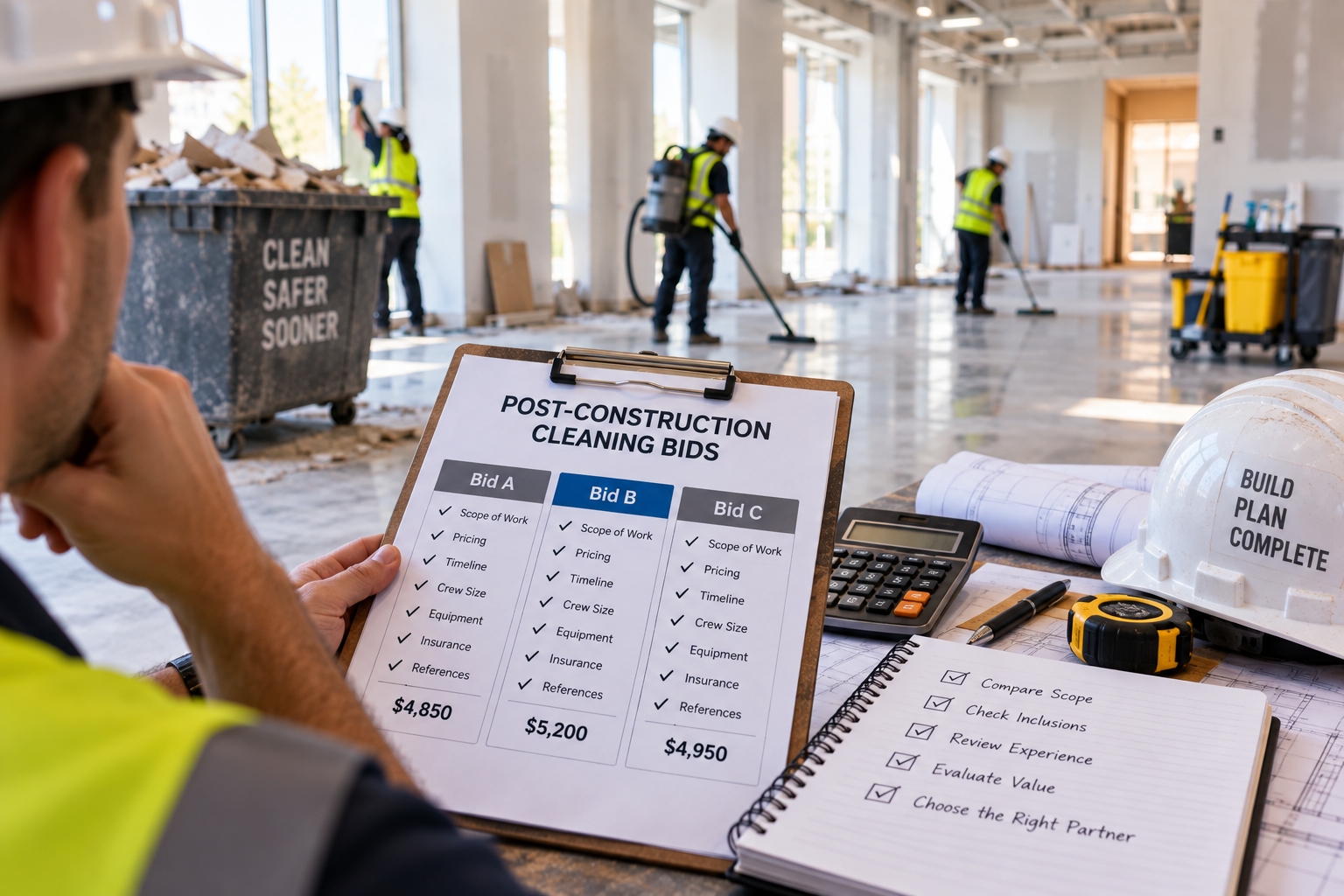
Table of Contents
- •Why Post-Construction Cleaning Bids Can Vary So Much
- •20 Questions Every GC Should Ask Before Awarding the Cleaning Contract
- -1. Which Cleaning Phases Are Included?
- -2. What Exact Square Footage and Areas Were Priced?
- -3. How Many Mobilizations Are Included?
- -4. Is Interior Glass Included?
- -5. Is Exterior Glass Included?
- -6. Who Removes Window Stickers and Protective Film?
- -7. Is High Glass or High Dusting Included?
- -8. Who Provides the Lift?
- -9. What Floor Cleaning Is Included?
- -10. Are Cabinet and Casework Interiors Included?
- -11. Who Owns Paint, Caulk, Adhesive and Grout Residue?
- -12. Who Removes Bulk Construction Debris?
- -13. Is Cleaning-Generated Trash Disposal Included?
- -14. What Working Hours Were Assumed?
- -15. Are Prevailing Wage, Union or PLA Requirements Included?
- -16. Are Security, Badging and Background Requirements Included?
- -17. What Is the Touch-Up Cleaning Allowance?
- -18. What Happens if Other Trades Re-Contaminate a Cleaned Area?
- -19. What Is Specifically Excluded?
- -20. How Will the Final Clean Be Accepted?
- •The GC's Apples-to-Apples Bid Comparison Matrix
- •Why Scope Gaps Become Change Orders
- •The Lowest Bid vs. the Lowest Total Cost
- •How to Write a Better Post-Construction Cleaning Bid Package
- •Massachusetts Post-Construction Cleaning Bids: Local Conditions Matter
- •Enterprise Cleaning Corporation's GC Bid-Planning Resources
- •Before You Award the Cleaning Subcontract
- -Need Help Building or Reviewing a Post-Construction Cleaning Scope?
For a General Contractor, comparing post-construction cleaning bids can look deceptively simple. Three contractors submit proposals. One is $42,000, another is $48,000, and the third is $54,000. It is tempting to conclude that the $42,000 proposal is the best value.
But what if the lowest bidder excluded exterior glass? What if Touch-Up Cleaning is not included? What if the bidder assumed one mobilization while the project requires five phased turnovers? What if VCT finishing, high dusting, lift work, sticker removal or cabinet interiors are missing? Then the three contractors are not bidding the same job.
For General Contractors, construction managers, estimators, project executives and superintendents, the most important rule when evaluating a commercial post-construction cleaning proposal is simple: Compare the scope before you compare the price. A properly structured bid comparison can reduce change orders, eliminate scope gaps, improve project turnover and help the GC understand what the cleaning subcontract will actually deliver.
GC Bid Rule
A cleaning proposal is only “low” if it includes the work the project actually requires. An excluded service that must be added later is not a savings.
Why Post-Construction Cleaning Bids Can Vary So Much
Post-construction cleaning is labor-intensive, and productivity changes dramatically based on the building and site conditions. A single-story warehouse with open floor space is different from a multi-story office building containing glass partitions, finished millwork, elevators, carpet, VCT, tile, restrooms and detailed owner-turnover requirements.
Price differences can also come from assumptions. One bidder may include Rough Cleaning, Final Cleaning and Touch-Up Cleaning. Another may price only the Final Clean. One may include interior and exterior glass. Another may exclude everything above ten feet. The GC's objective should therefore be to create an apples-to-apples construction cleaning bid comparison before award.
20 Questions Every GC Should Ask Before Awarding the Cleaning Contract
1. Which Cleaning Phases Are Included?
Confirm whether the proposal includes Rough Cleaning, Final Construction Cleaning, Touch-Up / Punch Cleaning and any pre-occupancy cleaning. These are separate stages with different labor requirements.
2. What Exact Square Footage and Areas Were Priced?
Confirm floors, wings, rooms, mechanical spaces, stairs, elevators, loading areas and any exterior zones. “Entire project” can mean different things to different bidders.
3. How Many Mobilizations Are Included?
A continuous five-day operation is different from returning to the project five separate times. Phased turnover can create additional travel, setup, equipment movement, supervision and scheduling costs.
4. Is Interior Glass Included?
Define windows, door glass, storefronts, glass partitions, sidelights, mirrors and other interior glazing. Large quantities of glass can materially affect labor.
5. Is Exterior Glass Included?
Never assume exterior windows are part of the base Final Clean. Identify the elevations, access method and whether specialty equipment is required.
6. Who Removes Window Stickers and Protective Film?
Labels and film can require significant detail labor. The proposal should state whether removal is included and whether unusual adhesive residue is excluded.
7. Is High Glass or High Dusting Included?
Beams, exposed structure, piping, elevated ledges and high glazing can require lifts and slower production. Define the height and surfaces before award.
8. Who Provides the Lift?
If a scissor lift or boom lift is required, determine whether the GC or cleaning contractor provides it, who operates it and what site certifications are required.
9. What Floor Cleaning Is Included?
Vacuuming and damp mopping are different from carpet extraction, machine scrubbing, VCT strip-and-finish, tile-and-grout cleaning or concrete scrubbing. Match the bid to the flooring specifications.
10. Are Cabinet and Casework Interiors Included?
Interior shelves, drawers and casework can add substantial detail time on office, healthcare, education, laboratory and residential projects. State the requirement clearly.
11. Who Owns Paint, Caulk, Adhesive and Grout Residue?
Normal cleaning is not the same as corrective residue removal. Identify paint drips, overspray, caulk, epoxy, adhesive, mortar and grout haze during the walkthrough and assign responsibility. Learn more about trade boundaries in our guide on Who Is Responsible for Cleaning What on a Construction Project.
12. Who Removes Bulk Construction Debris?
Clarify pallets, lumber, drywall scraps, packaging, abandoned material and trade-generated debris. Also identify who provides dumpsters or disposal containers.
13. Is Cleaning-Generated Trash Disposal Included?
Even when trades remove their own construction debris, the cleaning operation generates bags of dust, disposable materials and collected waste. Define the approved disposal route.
14. What Working Hours Were Assumed?
Night, weekend and restricted-hour work may affect crew availability, supervision and productivity. Make sure all bidders price the same work window.
15. Are Prevailing Wage, Union or PLA Requirements Included?
Massachusetts public and certain project-specific requirements can materially affect labor cost. The GC should communicate all applicable wage, union, PLA, orientation, PPE and site rules before bidding.
16. Are Security, Badging and Background Requirements Included?
Healthcare, education, life-science, government and secure facilities may require badging, escorts, orientations or background checks. These conditions affect mobilization and should not be discovered after award.
17. What Is the Touch-Up Cleaning Allowance?
After Final Cleaning, punch-list activity can create footprints, fingerprints, dust and debris. Determine whether one Touch-Up Clean, a defined number of labor hours, or another arrangement is included. Avoid common turnover bottlenecks by reviewing our companion article on 17 Post-Construction Cleaning Mistakes That Delay Project Turnover.
18. What Happens if Other Trades Re-Contaminate a Cleaned Area?
The cleaning subcontract should distinguish cleaning deficiencies from re-cleaning caused by new construction activity. Otherwise, responsibility can become disputed during closeout.
19. What Is Specifically Excluded?
Read the exclusions before reading the price. Exterior glass, lifts, high dusting, specialty floors, residue, appliances, pressure washing and repeated mobilizations are common areas that may be excluded.
20. How Will the Final Clean Be Accepted?
Define who inspects the work, how deficiencies are communicated, the correction window and when an area is considered complete. A coordinated punch list is far more efficient than multiple people issuing separate requests.
The GC's Apples-to-Apples Bid Comparison Matrix
Use this evaluation matrix when comparing competing commercial post-construction cleaning bids:
Scope Item Bidder A Bidder B Bidder C Rough Clean Included / Excluded Included / Excluded Included / Excluded Final Clean Included / Excluded Included / Excluded Included / Excluded Touch-Up Clean Included / Excluded Included / Excluded Included / Excluded Interior Glass Included / Excluded Included / Excluded Included / Excluded Exterior / High Glass Included / Excluded Included / Excluded Included / Excluded High Dusting / Lift Work Included / Excluded Included / Excluded Included / Excluded Specialty Floor Care Included / Excluded Included / Excluded Included / Excluded Residue Removal Included / Excluded Included / Excluded Included / Excluded Mobilizations Included ___________ ___________ ___________ Touch-Up Allowance ___________ ___________ ___________
Why Scope Gaps Become Change Orders
A post-construction cleaning change order often begins with a sentence such as, “We thought that was included.” The GC thought exterior glass was included. The cleaner priced interior glass only. The GC expected three return trips. The proposal included one mobilization. The owner expects VCT to have a finished appearance. The cleaner priced only damp mopping.
These situations are usually easier to prevent during estimating than resolve during turnover. A strong construction cleaning scope of work should define areas, phases, specialty services, exclusions, site conditions, responsibilities, schedule and acceptance criteria before the subcontract is issued.
The Lowest Bid vs. the Lowest Total Cost
General Contractors should evaluate the total project impact of the cleaning subcontract, not only the initial price. A cleaning contractor that understands phased turnover, communicates readiness concerns, identifies scope gaps early and coordinates with the superintendent may prevent expensive re-cleaning and last-minute problems. Conversely, a low bid that omits critical scope can become more expensive once additions, mobilizations and schedule pressure appear.
This does not mean the highest cleaning bid is automatically the best bid. It means the GC should first normalize the scope. Once bidders are pricing equivalent work, price becomes a much more meaningful comparison.
How to Write a Better Post-Construction Cleaning Bid Package
For GCs seeking better proposals, the bid package should provide more than a project name and square footage. Include:
Expected Rough, Final and Touch-Up phases
Floor-by-floor or area-by-area square footage
Anticipated mobilizations
Glass scope (interior, exterior, heights)
Floor types and finish specifications
High work and lift requirements
Unusual residue or heavy soil expectations
Disposal responsibilities and dumpsters
Working hours and shifts
Wage, prevailing wage, or labor requirements
Security, badging, and access conditions
Target turnover dates and acceptance expectations
The more clearly the GC defines the project, the less contingency each bidder needs to carry for unknown conditions — and the easier it becomes to identify the contractor providing the strongest value.
Massachusetts Post-Construction Cleaning Bids: Local Conditions Matter
For post-construction cleaning in Massachusetts, project conditions can vary widely across Worcester, Central Massachusetts, MetroWest and Greater Boston. Urban loading restrictions, elevators, parking, occupied buildings, prevailing-wage requirements, secure facilities, winter conditions and compressed schedules can all influence production.
A contractor bidding a suburban single-story facility may approach the project differently from a multi-floor Boston-area project with limited loading and after-hours access. General Contractors should make these conditions visible during the bid process so the cleaning contractor can build a realistic staffing and mobilization plan. Learn more about our statewide services on our Massachusetts post-construction cleaning overview.
Enterprise Cleaning Corporation's GC Bid-Planning Resources
Enterprise Cleaning Corporation has developed a series of resources specifically to help General Contractors estimate, scope, schedule and manage post-construction cleaning. These tools are designed to make the cleaning subcontract easier to define before award and easier to manage during closeout:
GC Post-Construction Cleaning Scope of Work Builder
GC Post-Construction Cleaning Responsibility Matrix
25-Point Final Clean Readiness Scorecard
Construction Cleaning Schedule Calculator
Post-Construction Cleaning Cost & Budgeting Guide
Rough Cleaning Checklist
Final Cleaning Checklist
Touch-Up Cleaning Checklist
GC-to-Owner Janitorial Transition Checklist
Before You Award the Cleaning Subcontract
If you remember only one point from this guide, make it this: Do not ask which post-construction cleaning bid is cheapest until you know whether the bidders are pricing the same scope. Normalize the phases. Normalize the areas. Normalize the glass. Normalize the floors. Normalize the mobilizations. Normalize the Touch-Up requirement. Identify exclusions. Then compare price. That process gives the General Contractor a much better opportunity to award a cleaning subcontract based on real value rather than an incomplete number.
GC Estimating & Bidding Partner
Need Help Building or Reviewing a Post-Construction Cleaning Scope?
Enterprise Cleaning Corporation can review the project, identify scope gaps and coordinate Rough, Final and Touch-Up cleaning around the GC's turnover schedule.
Alex Puchulu | Director of Sales
508-304-2369 • alex@enterprisecleaningcorp.com
Enterprise Cleaning Corporation • 99 Hartwell Street, West Boylston, MA
Publication note: This article is an educational GC planning resource. Project specifications, contracts, subcontracts, safety requirements and agreed written terms control actual scope, pricing and responsibility.