High-Touch Disinfecting Services in Massachusetts: Why New England Businesses Need a Year-Round Disinfection Strategy
Why New England businesses need a year-round high-touch disinfection strategy. EPA-registered disinfectants, dwell-time compliance, color-coded microfiber systems, and winter virus prevention.
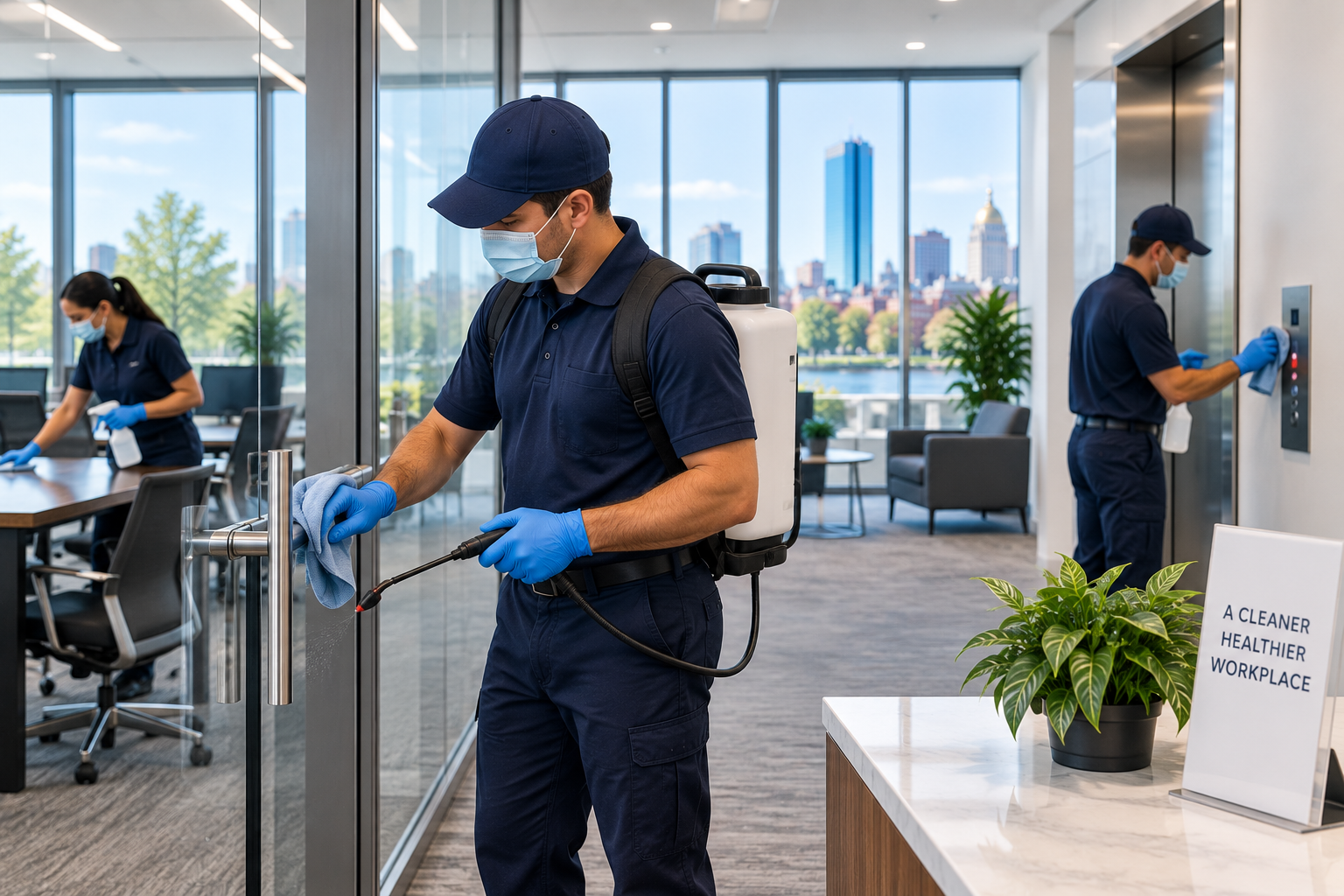
Table of Contents
- •What Is High-Touch Disinfecting?
- •Cleaning vs. Sanitizing vs. Disinfecting: What's the Difference?
- •Why Is High-Touch Disinfecting Important?
- •How Often Should High-Touch Surfaces Be Disinfected?
- •A Four-Season Disinfection Strategy for New England Businesses
- -Winter: The Peak Respiratory-Virus Season
- -Spring: Deep Clean & Environmental Reset
- -Summer: Consistent High-Traffic Maintenance
- -Fall: Winter Preparation & Protocol Review
- •Which Industries Need High-Touch Disinfecting Most Often?
- •The Most Common Disinfecting Mistake: Ignoring Contact Time & Dwell Requirements
- •Preventing Cross-Contamination with Color-Coded Systems
- •Professional Commercial Cleaning in Central Massachusetts
- -Protect Your Workplace With a Smarter Disinfection Strategy
For businesses throughout Massachusetts and New England, keeping a facility clean is about much more than appearance. The surfaces employees, customers, patients, students, visitors, and vendors touch throughout the day can become critical points where germs accumulate and spread.
Door handles. Elevator buttons. Light switches. Restroom fixtures. Faucets. Breakroom counters. Conference tables. Shared phones. Touchscreens. Handrails. Reception counters.
These are known as high-touch surfaces, and they deserve specialized attention in every professional commercial cleaning program.
At Enterprise Cleaning Corporation, we believe an effective cleaning program must be based on how a facility is actually used. That means identifying the highest-traffic routes and most frequently handled fixtures, then tailoring a scientific cleaning and disinfecting protocol appropriate for the building.
For businesses searching for high-touch disinfecting services in Massachusetts, the most critical foundation to understand is that cleaning, sanitizing, and disinfecting are related—but fundamentally different.
What Is High-Touch Disinfecting?
High-touch disinfecting is the targeted cleaning and chemical disinfection of surfaces that are repeatedly contacted by multiple people throughout a business or commercial property.
Common high-touch surfaces include:
Entrance, vestibule, and interior door handles
Push plates and emergency exit panic bars
Light switches and thermostat controls
Elevator buttons and call panels
Staircase and hallway handrails
Conference room tables and chair armrests
Shared desk phones, headsets, and intercoms
Keyboards, mice, and IT accessories when specified
Touchscreens, time clocks, and equipment control panels
Vending machine buttons and keypad touchpoints
Cabinet pulls and coffee station dispensers
Restroom stall latches, toilet flush levers, and sink faucets
Soap dispensers, hand dryers, and paper towel levers
Shared industrial tools and warehouse machinery controls
Every facility is unique. A manufacturing plant has shared equipment and shift time clocks, while an office building features conference rooms and shared printers. An effective program is customized to actual building traffic rather than a generic checklist.
Cleaning vs. Sanitizing vs. Disinfecting: What's the Difference?
These terms are often confused, but each performs a distinct scientific role:
Cleaning: Physically removes dirt, soil, grease, and many germs from a surface using water, detergent, and friction.
Sanitizing: Reduces remaining bacteria to safe levels designated by public health codes.
Disinfecting: Uses EPA-registered chemical agents to kill specified viruses, bacteria, and fungi remaining on a surface.
Critical Rule: A dirty surface cannot be properly disinfected. Applying disinfectant over visible grease, dust, or organic soil neutralizes the chemical's active ingredients before it reaches the surface. Thorough physical cleaning must always precede disinfection.
Why Is High-Touch Disinfecting Important?
Consider the front entrance of an active office building: An employee enters and pushes the handle. A delivery driver grabs it. Ten clients enter. Workers head to lunch and return. A contractor arrives. By afternoon, that single fixture has been touched hundreds of times.
A smart commercial cleaning program doesn't treat every square foot the same. A perimeter wall that nobody touches doesn't need nightly disinfection, whereas a restroom faucet or elevator button handled hundreds of times daily requires consistent attention. Cleaning frequency must follow risk, foot traffic, and use.
How Often Should High-Touch Surfaces Be Disinfected?
Frequency should be calculated based on employee population, shift patterns, and public traffic:
Low-Traffic Professional Offices: High-touch surfaces are serviced on every scheduled janitorial visit (typically 2 to 3 times per week).
Medium- to High-Traffic Facilities: Daily high-touch cleaning and disinfection (5 days per week), prioritizing entrances, restrooms, breakrooms, and shared conference equipment.
High-Risk or High-Volume Operations: Multiple disinfections per day for healthcare facilities, daycare centers, schools, senior living facilities, or during known viral outbreaks.
A Four-Season Disinfection Strategy for New England Businesses
Winter: The Peak Respiratory-Virus Season
December through March is the most demanding period in Massachusetts. Commercial buildings are sealed tight against the cold, forced-air heat circulates continuously, and employees spend breaks indoors. Winter coincides with peak influenza, RSV, and common cold transmission. Increasing high-touch disinfection at door handles, elevator buttons, and breakrooms is vital to keeping your workforce healthy and minimizing absenteeism.
Spring: Deep Clean & Environmental Reset
As winter weather recedes, mud, rain, and heavy tree pollen take over. Spring is the time for a commercial deep cleaning that pairs high-touch sanitization with commercial carpet extraction, tile and grout steam cleaning, and window washing to remove months of accumulated indoor grime.
Summer: Consistent High-Traffic Maintenance
While some corporate offices see lighter summer loads, hotels, medical facilities, restaurants, and retail properties experience peak customer volume. Summer is also the premier time for schools and educational campuses to perform extensive deep sanitization while students are on vacation.
Fall: Winter Preparation & Protocol Review
September through November marks the return of full office occupancy, school reopenings, and dropping temperatures. Fall is the ideal checkpoint to evaluate your janitorial scope and ensure high-touch protocols are reinforced before winter flu season arrives.
Which Industries Need High-Touch Disinfecting Most Often?
Medical & Dental Practices: High patient turnover in waiting areas, exam rooms, check-in kiosks, and clinical restrooms requires adherence to strict healthcare infection-control standards.
Schools & Daycares: Young children share toys, desks, and tabletops constantly; frequent sanitizing of handrails, drinking fountains, and classroom fixtures is essential.
Senior Living & Healthcare Campuses: Older adults are vulnerable to seasonal pathogens; common dining rooms and handrails demand multi-shift care.
Fitness Centers & Gyms: Free weights, machines, touchscreens, locker benches, and handles experience constant skin contact and sweat.
Manufacturing Facilities: Shared machinery controls, crane pendants, breakrooms, and time clocks require tailored industrial sanitization between shifts.
Warehouses & Logistics Hubs: Multi-shift operations with rotating forklift operators require regular steering wheel, scanner, and dock door handle disinfection.
Corporate Offices & Banks: Shared conference rooms, printer hubs, coffee bars, and client transaction counters project executive cleanliness and protect staff health.
Automobile Dealerships: Showroom tables, vehicle door handles, and customer waiting areas require daily sanitization to impress prospective buyers.
The Most Common Disinfecting Mistake: Ignoring Contact Time & Dwell Requirements
Spraying a disinfectant and instantly wiping it dry does not disinfect the surface.
The U.S. Environmental Protection Agency (EPA) specifically states that the required contact time is the exact period a disinfectant needs to remain on a surface to be effective, and that the surface must remain visibly wet for that entire period. Depending on the product and target pathogen, this dwell time typically ranges from 1 to 10 minutes.
Furthermore, the Centers for Disease Control and Prevention (CDC) explicitly recommends cleaning surfaces with soap or detergent before applying disinfectants because dirt, grease, and other impurities can interfere with and deactivate the disinfectant's active ingredients. Professional commercial disinfecting services ensure that physical pre-cleaning and full dwell-time compliance are rigorously observed.
Preventing Cross-Contamination with Color-Coded Systems
A microfiber towel used to wipe a restroom toilet handle should never be used on an office desk or breakroom table. Enterprise Cleaning Corporation enforces strict color-coded microfiber systems (e.g., red for restrooms, blue for glass, green for general surfaces) and dedicated equipment to ensure cleaning never spreads contamination from one room to another.
Professional Commercial Cleaning in Central Massachusetts
Enterprise Cleaning Corporation provides customized commercial cleaning and high-touch disinfection programs for commercial facilities throughout Worcester, West Boylston, Shrewsbury, Framingham, Leominster, Fitchburg, Lowell, Waltham, and surrounding Central Massachusetts and MetroWest communities.
Comprehensive Disinfection Across Central Massachusetts: Enterprise Cleaning Corporation provides tailored commercial disinfecting services in Massachusetts, specialized office disinfecting services, medical office cleaning, school cleaning, manufacturing facility cleaning, and warehouse cleaning throughout Worcester, MA and surrounding communities.
Protect Your Workplace With a Smarter Disinfection Strategy
A facility does not have to look dirty to harbor bacteria and viruses. Ensure your employees, clients, and visitors are protected by partnering with Enterprise Cleaning Corporation for targeted, professional high-touch disinfection.
Contact our team today to evaluate your facility traffic and design a customized commercial cleaning plan.
Request a Commercial Cleaning Quote Contact Our Team
It’s not clean… until it’s ENTERPRISE Clean.