
Why Every Office and Manufacturing Building Needs to Strip and Wax Its VCT Floors
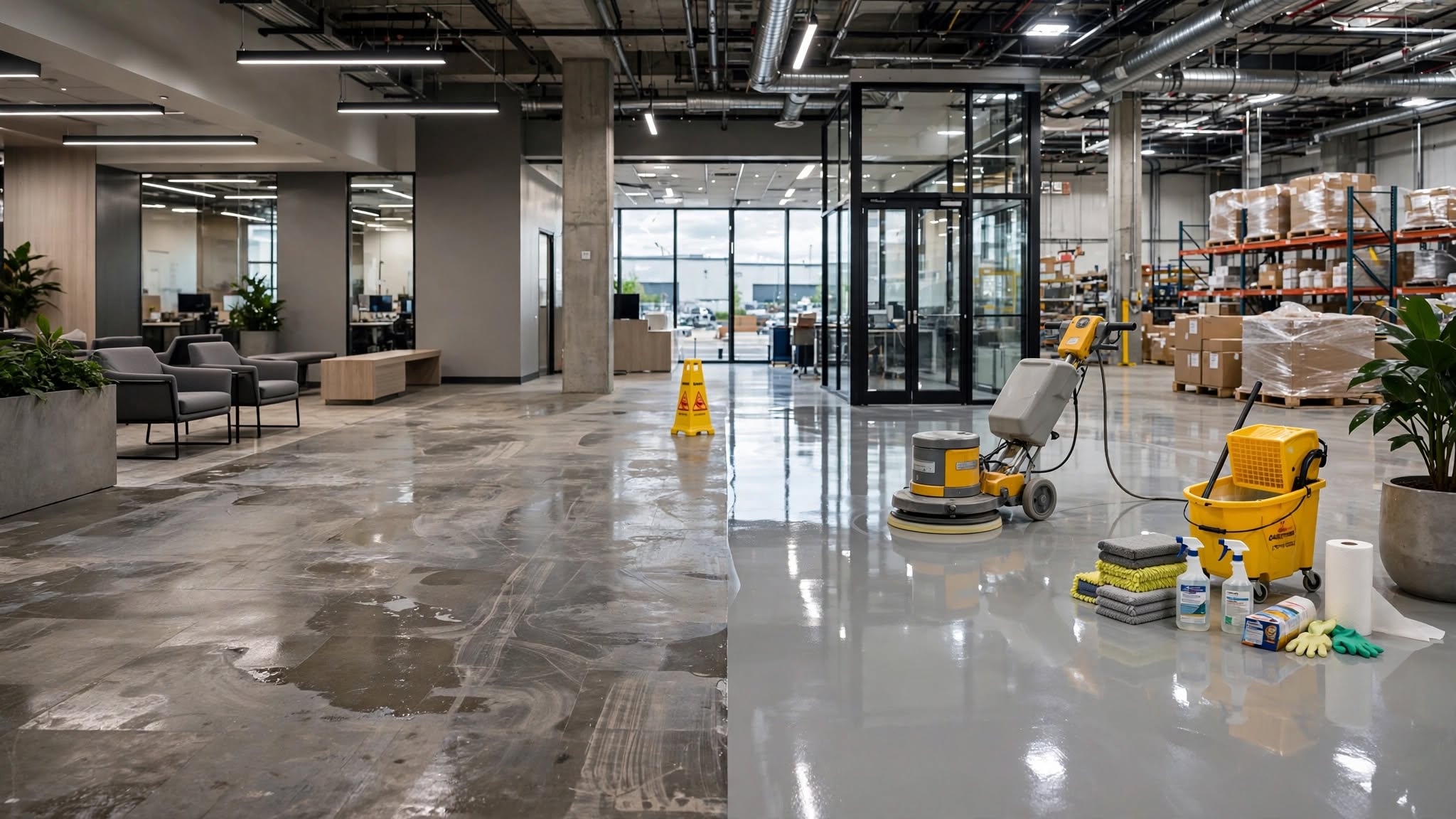
Table of Contents
- •Why VCT Floor Stripping and Waxing Matters in New England
- •How Often Should Commercial VCT Be Stripped and Waxed?
- •Warning Signs Facility Managers Should Not Ignore
- •VCT Floor Care Is Also a Safety Issue
- •What Professional VCT Floor Stripping and Waxing Actually Includes
- •Can You Just Add More Wax Instead?
- •Why Manufacturing Floors Need Extra Attention
- •Plan VCT Floor Stripping and Waxing Around the New England Calendar
- •Enterprise Cleaning Corporation and Commercial Floor Care
- •The Bottom Line
- •
If you manage an office, school, medical building, warehouse, or manufacturing facility around Worcester, you have probably seen VCT flooring. It is the familiar commercial tile used in corridors, break rooms, production support areas, classrooms, and older lobbies.
VCT is popular because it is durable, repairable, and built for heavy use. Armstrong still markets commercial VCT for areas that handle heavy foot traffic and rolling loads. But traditional VCT is not maintenance-free. Even when a product has a temporary factory coating for shipping or installation, its long-term appearance and protection depend on a proper floor-finish program. Armstrong's current commercial materials continue to include floor polish and restorative-maintenance guidance for VCT, while 3M distinguishes homogeneous products such as VCT from layered products such as LVT when discussing stripping procedures.
That is why VCT floor stripping and waxing should be treated as preventive building maintenance, not a once-in-a-while cosmetic job.
Why VCT Floor Stripping and Waxing Matters in New England
A Central Massachusetts winter can be wicked hard on commercial floors.
Snow, slush, sand, road salt, and de-icing chemicals get carried through entrances on boots, carts, pallet jacks, and delivery traffic. It does not take long for that mess to travel from the lobby into hallways and work areas.
People responsible for maintaining VCT routinely report de-icer residue making floors sticky, dull, and difficult to mop. Regional floor-care professionals also warn that salt, moisture, and abrasive grit can haze commercial finishes and shorten their useful life.
The finish is supposed to take that beating so the tile does not have to.
Without enough finish, grit works like fine sandpaper. Shoes, chair legs, carts, and wheels grind it against the surface all day. Eventually, traffic lanes become gray, scratched, or dull.
Once that wear reaches the tile itself, another pass with a mop is not going to bring the floor back.
VCT floor stripping and waxing removes worn and contaminated finish and rebuilds the protective layer before the underlying flooring takes the damage.
How Often Should Commercial VCT Be Stripped and Waxed?
There is no honest one-size-fits-all answer.
For many Central Massachusetts offices, once a year is a sensible starting point. High-traffic corridors, medical buildings, cafeterias, schools, and manufacturing facilities may need VCT floor stripping and waxing closer to every six months.
Extremely hard-use areas may need attention more frequently, but that does not automatically mean performing a full strip every time.
AreaTypical Planning RangePrivate offices and low-traffic rooms12 to 24 monthsGeneral offices and standard corridors9 to 12 monthsLobbies, break rooms and busy hallwaysAround every 6 monthsHeavy manufacturing, healthcare or retail traffic3 to 6 months, based on condition
Real-world floor technicians frequently ask whether they should strip every year or rely on top scrubbing and recoating for several years between complete strips. The useful takeaway is that inspection matters more than blindly following a calendar. Proper interim maintenance can extend the existing finish and avoid unnecessary stripping.
Warning Signs Facility Managers Should Not Ignore
If your floor looks dirty again shortly after it has been mopped, the problem may not be the nightly cleaning crew.
The finish may simply be worn out.
Uneven shine is another giveaway. If the edges still look glossy but the center of the hallway is flat and gray, pedestrian and cart traffic has probably worn down the protective coating.
Yellowing may point to old finish buildup, trapped dirt, or years of adding new coats without properly removing contaminated layers.
Another common question is, "Why won't my VCT come clean no matter what we use?" In one recent commercial-floor discussion, what looked like a cleaning problem was actually bare or nearly bare VCT absorbing soil because the protective finish was gone.
When you reach that point, VCT floor stripping and waxing gives the floor a clean base instead of simply covering the problem with another coat.
VCT Floor Care Is Also a Safety Issue
A shiny floor is nice. A safe, manageable floor is more important.
Facility managers have to think about moisture, residue, tracked-in snow, loose grit, and surface condition throughout the year.
The U.S. Bureau of Labor Statistics recorded 479,480 cases involving days away from work due to falls, slips, and trips in 2024. That number is not specific to VCT floors, but it shows why maintaining walking surfaces and controlling winter moisture deserves serious attention in every commercial building.
A sound floor finish also makes routine maintenance easier.
Spills are easier to remove. Dirt stays closer to the surface. Salt residue can be addressed before it works into the flooring. Your nightly cleaning crew spends less time fighting worn surfaces and more time maintaining a consistent standard.
What Professional VCT Floor Stripping and Waxing Actually Includes
A proper job begins with removing loose soil and protecting nearby areas.
A professional stripping solution is applied to break down the existing finish. Floor equipment agitates the surface, while corners and edges usually require additional hand work.
The old finish and slurry are then removed.
Rinsing is a critical step. In professional floor-care discussions, leftover stripper residue is repeatedly identified as a reason fresh finish turns cloudy, streaky, or fails to bond properly.
Once the floor is completely clean, neutral, and dry, several thin coats of commercial floor finish are applied according to the product requirements and the traffic expected in the building.
VCT floor stripping and waxing is therefore more than "putting wax on the floor." Stripping, rinsing, drying, coating, cure time, and the maintenance program afterward all determine how well the floor performs.
Can You Just Add More Wax Instead?
Sometimes.
If the existing coating is clean, properly bonded, and only lightly worn, a scrub-and-recoat may be the smarter option. It restores protection without taking the flooring completely back to bare tile.
But if the finish is yellow, deeply scratched, contaminated with winter salt, stained with grease, or completely worn away in traffic lanes, another coat may simply trap the problem underneath.
This is one of the most common questions facility teams ask because recoating takes less time and money than a complete restoration.
The answer should come from inspecting the floor.
A reputable contractor should be able to explain why VCT floor stripping and waxing is necessary, or tell you when it is not.
Why Manufacturing Floors Need Extra Attention
Manufacturing facilities around Worcester, Leominster, Fitchburg, Auburn, Shrewsbury, and the surrounding industrial corridors can be particularly rough on VCT.
Office workers bring foot traffic. Manufacturing buildings may add grease, production dust, chair traffic, carts, toolboxes, pallet jacks, and multiple shifts.
A recent floor-care discussion described a mechanics-area VCT floor where grease from workers' footwear and repeated chair movement destroyed the finish unusually fast. The recommendation was not constant stripping. It was better interim maintenance and addressing the specific sources of wear.
That distinction matters.
A facility with one quiet hallway and one heavy-production corridor should not maintain both floors on exactly the same schedule.
Plan VCT Floor Stripping and Waxing Around the New England Calendar
Central Massachusetts gives facility managers four different floor-care seasons.
Winter means salt and slush. Spring means mud and winter cleanup. Manufacturing facilities add year-round dust and rolling traffic. Offices and medical buildings have appearance standards every business day.
The smart move is to schedule VCT floor stripping and waxing before the floor reaches the failure point.
Offices may use a holiday weekend. Schools can use vacation periods. Manufacturing plants can coordinate work around shutdowns or low-production windows.
For many New England properties, early spring is also a logical time to assess floor condition after months of road salt, sand, and snow.
Planned maintenance is a lot easier to budget than premature flooring replacement.
Enterprise Cleaning Corporation and Commercial Floor Care
Enterprise Cleaning Corporation provides stripping, waxing, buffing, polishing, and other commercial floor-care services for offices, manufacturing and industrial facilities, medical buildings, schools, warehouses, distribution facilities, and professionally managed commercial properties.
The company serves Central Massachusetts as well as Rhode Island and Southern New Hampshire and has operated in the region for more than two decades. Enterprise Cleaning reports a 97 percent client retention rate, has received four Worcester Business Journal Best of Business awards, and has been BBB accredited since 2007. Commercial floor care, including VCT stripping, waxing and buffing, is already part of the company's service offering.
For facility managers, the advantage is that VCT floor stripping and waxing can become part of the same planned maintenance program as nightly janitorial cleaning rather than becoming an emergency job when the floor finally looks shot.
Enterprise Cleaning Corporation can assess traffic patterns, operating hours, winter wear, and the present condition of the finish, then recommend whether you need a complete strip, scrub-and-recoat, or routine burnishing.
To schedule an on-site walkthrough, visit enterprisecleaningcorp or call (508) 890-1000.
The Bottom Line
VCT can take a beating. That is one reason you still see so much of it in New England offices, factories, schools, medical buildings, and commercial properties.
But durable does not mean maintenance-free.
VCT floor stripping and waxing keeps a renewable protective layer between your expensive flooring and the salt, grit, chemicals, shoes, carts, and equipment attacking it every day.
For many buildings, once or twice a year is a strong planning point, supported by periodic scrubbing, recoating, and burnishing between full restorations.
Do not wait until the hallway looks permanently gray.
At that stage, routine cleaning may no longer be enough.