
Table of Contents
- •Vacuuming and deep cleaning are two different jobs
- •How often should commercial carpet be professionally cleaned?
- •Carpet cleaning methods, and when each one fits
- •Carpet condition affects more than appearance
- •Cleaning carpet in a building that cannot stop
- •Carpet care by facility type
- •What to ask before hiring a commercial carpet cleaning company
- •Enterprise Cleaning Corporation across Central Massachusetts, Rhode Island and Southern New Hampshire
- -Request a walkthrough
Most commercial carpet needs professional deep cleaning every three to six months, and entrances, lobbies and corridors need it more often than that. Nightly vacuuming handles surface debris. It does not lift the ground in soil, oils and winter salt that flatten the fibers and turn light carpet grey. Those are two different jobs, and skipping the second one is what makes carpet look worn out years before it should.
Vacuuming and deep cleaning are two different jobs
Nightly vacuuming lifts the loose dry soil sitting on top of the fibers, and in an occupied building it should happen every night. The problem is what stays behind. Foot traffic drives fine grit down to the base of the pile where a vacuum head cannot reach it, and that grit works like sandpaper against the fiber every time someone walks across it. Add spilled coffee, hand lotion, toner dust and the road salt that rides in on boots from November through March, and you have a sticky residue that grabs and holds every new bit of soil that lands on it.
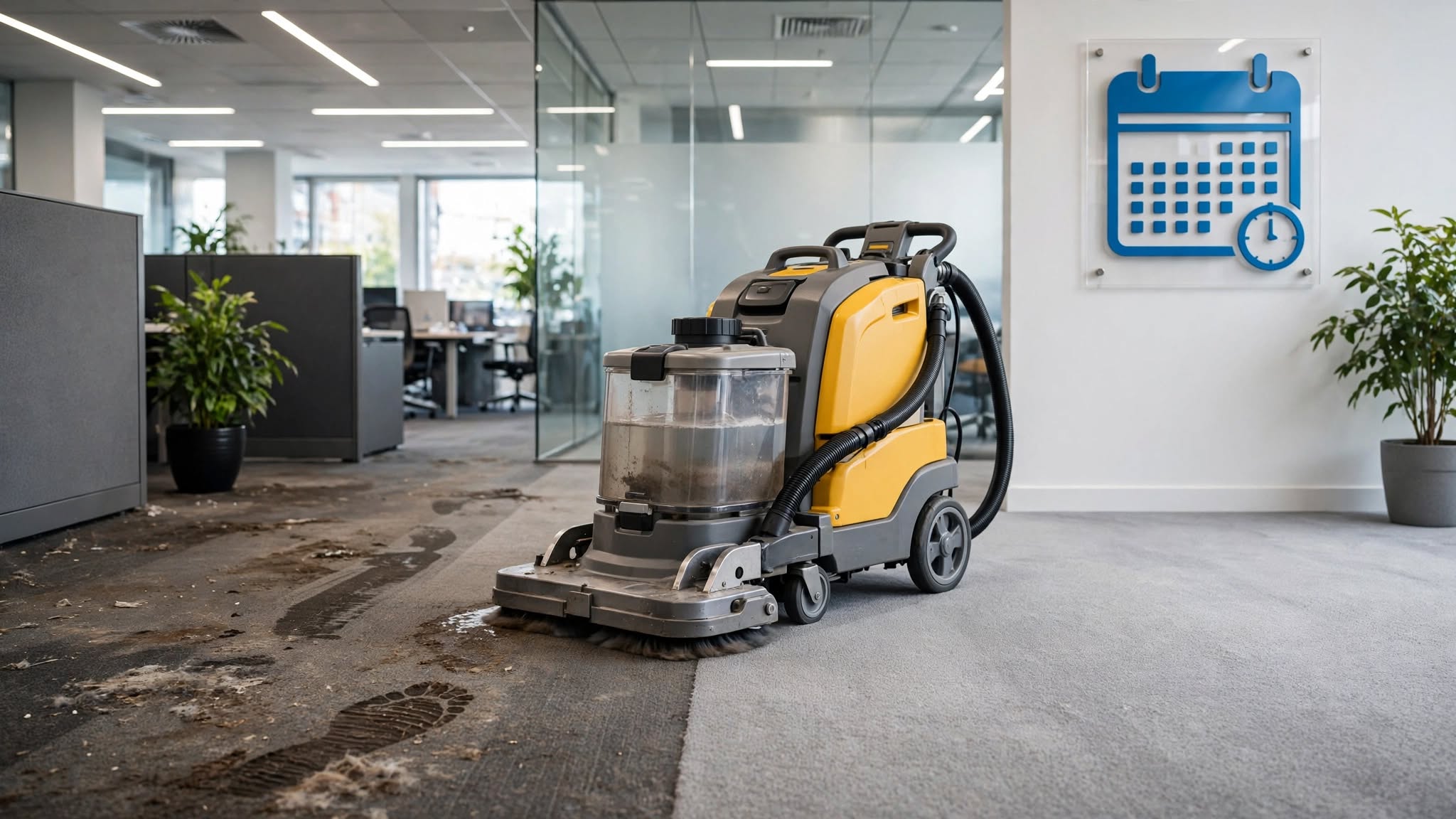
Professional commercial carpet cleaning works on that lower layer. A proper service runs a sequence rather than a single pass: inspect the carpet and confirm the fiber type, vacuum thoroughly, treat spots and traffic lanes individually, apply a pre-spray that breaks the bond between soil and fiber, agitate, extract, groom the pile so it dries standing up, then manage airflow so the space is back in use on schedule. Skip the agitation or rush the extraction and you get carpet that looks clean for two weeks and then resoils faster than it did before.
How often should commercial carpet be professionally cleaned?
There is no single answer for a whole building, which is why so many facilities either overspend on space nobody walks through or let the lobby go grey. Zone the building by traffic instead, then set a frequency for each zone.
Light traffic (private offices, executive suites, storage and file rooms): every 9 to 12 months
Moderate traffic (general office floors, conference rooms, break rooms): every 6 months
Heavy traffic (lobbies, main corridors, call centers, classrooms, clinic waiting areas): every 3 months
Very heavy traffic (entrances, elevator landings, cafeteria approaches, stair landings): monthly to quarterly, with interim spot care
Three variables push those intervals shorter: a main entrance without proper walk-off matting, a light colored carpet, and a New England winter. Buildings in Worcester, Providence and Nashua all deal with five months of sand, salt and slush tracked across the same twenty feet of entry carpet, and that entry zone will always need more attention than the rest of the floor plate.
Carpet cleaning methods, and when each one fits
Most facility managers are told their carpet will be steam cleaned and leave it there. The method actually matters, because each one trades depth against downtime.
Hot water extraction, often called carpet steam cleaning. Hot solution is injected under pressure and pulled straight back out with the suspended soil. This is the deepest clean available and the one most carpet manufacturers expect. Dry time typically runs six to twelve hours, so it belongs on a Friday night or a scheduled shutdown.
Encapsulation. A polymer is worked into the pile, crystallizes around the soil, and then comes out with regular vacuuming over the following days. Carpet is dry in one to two hours. Excellent as interim maintenance between extractions, particularly in buildings that never fully close.
Bonnet cleaning. An absorbent pad on a rotary machine lifts surface soil quickly. It improves appearance fast before an inspection or a client visit, but it does not reach the base of the pile and should never be the only method in a program.
Dry compound cleaning. An absorbent compound is brushed in and vacuumed out with almost no moisture. This is the option for server rooms, 24 hour operations and any space that cannot be handed over wet.
The strongest programs combine them. Hot water extraction two to four times a year resets the carpet, and low moisture interim cleaning in the traffic lanes holds appearance in between without ever closing the space. Fiber type and the manufacturer's written care guidance decide the exact mix, which is a conversation worth having before the first cleaning rather than after a warranty claim.
Carpet condition affects more than appearance
Carpet is the largest filter in most commercial buildings. It traps dust, pollen, skin cells and whatever comes in on shoes, and it holds all of that until something disturbs it. A carpet that is vacuumed but never deep cleaned keeps releasing that load back into the air every time the floor gets busy, which matters in medical suites, schools and any building where occupants complain about stuffiness by mid afternoon.
There is a financial side too. Carpet replacement is a capital project with disruption, furniture moves and lead times attached. Cleaning is a maintenance line item. Grit left in the pile abrades the fiber until the traffic lanes look permanently dirty, and at that point no amount of cleaning brings them back. Many carpet manufacturers also require documented professional cleaning at set intervals, commonly every twelve to eighteen months, to keep their warranty valid. Facility managers who keep cleaning records have leverage in a warranty conversation. Those who do not, usually do not.
Cleaning carpet in a building that cannot stop
Nobody wants their lobby roped off at ten in the morning. Commercial carpet cleaning is scheduled around the operation, not the other way around, which usually means evenings, weekends or a phased approach that moves zone by zone across several nights so no department loses access at the same time.
Two practical details decide whether that goes smoothly. The first is dry time, which needs to be agreed in advance and supported with air movers rather than hoped for. The second is walk-off matting at every exterior entrance, sized properly and cleaned on its own schedule. Matting catches soil before it reaches the carpet and is the cheapest thing any facility can do to stretch the interval between cleanings.
Carpet care by facility type
A dental practice and a distribution center both have carpet, and almost nothing else about their carpet programs should look the same.
Medical and dental offices. Waiting rooms and corridors see constant traffic and the carpet is part of how patients judge the practice. Frequent low moisture cleaning keeps appearance steady between extractions, and fast dry times matter because these buildings open early.
Professional office buildings. The lobby, elevator landings and main corridors carry the impression, while private offices barely move. Spending the same on both is the most common carpet budgeting mistake in multi tenant buildings.
Schools and training facilities. Traffic is heavy, predictable and seasonal, and cleaning has to land in vacation windows. Documented cleaning intervals also support the indoor air quality conversations that come up with parents and staff.
Warehouses and manufacturing sites. Carpet is usually limited to front offices and break rooms, but it takes the worst of it because the soil arrives from the plant floor. Entry matting and a shorter interval on those few rooms solve most of it.
Property managers. Common area carpet gets judged by prospective tenants during tours, which means appearance work has to be schedulable on short notice rather than only quarterly.
What to ask before hiring a commercial carpet cleaning company
Most carpet complaints trace back to a vendor conversation that never happened. These six questions sort a maintenance partner from a truck with a wand on it.
Which method will you use on our fiber, and why that one over the alternatives?
What is the realistic dry time, and what happens if we need the space before then?
Who supervises the crew on site, and who answers the phone at six in the morning if something is wrong?
Are you insured and bonded for work inside an occupied commercial building?
Will you handle spot response between scheduled cleanings, or is every callback a separate job?
Can carpet care sit inside our existing janitorial contract rather than adding another vendor to manage?
That last question is usually the one that saves the most time. When carpet care is built into the nightly cleaning program, the same crew that vacuums the floor every night is the crew that notices the traffic lane starting to grey, and the problem gets scheduled before anyone in the building files a complaint.
Enterprise Cleaning Corporation across Central Massachusetts, Rhode Island and Southern New Hampshire
Enterprise Cleaning Corporation has cleaned commercial buildings across this region for more than two decades. The company is based at 99 Hartwell Street in West Boylston, Massachusetts, and is run by owner and president Steve Buchalter alongside director of operations Julio Biage, which means the people accountable for the work are the same people who own the company. That structure shows up in a 97 percent client retention rate, four Worcester Business Journal Best of Business awards and BBB accreditation held since 2007. Long standing clients include MacIntire Insurance and the Worcester Club. Crews serve Worcester, Shrewsbury, Westborough, Marlborough and the wider Central Massachusetts corridor, Providence, Warwick and Pawtucket in Rhode Island, and Nashua, Manchester and Salem in Southern New Hampshire.
Request a walkthrough
Carpet is usually the first thing a visitor notices and the last thing anyone budgets for. If the traffic lanes in your building are starting to show, a walkthrough will tell you whether you need a full extraction, interim maintenance, or a matting fix at the front door.
Get a commercial carpet cleaning quote. Call (508) 890-1000 or request an on-site walkthrough. Serving Central Massachusetts, Rhode Island and Southern New Hampshire.