Table of Contents
- •Cut to the chase
- •At a glance
- •What hospital janitorial services include
- •The infection control standard behind the work
- •Daily, discharge, and terminal cleaning
- -Daily clean
- -Discharge or between-patient clean
- -Terminal clean
- -Periodic deep work
- •Zoning a medical building by risk
- •Get a quote
- •What is different about outpatient and medical office sites
- •How to evaluate a medical cleaning contractor
- -1. Ask for the product list and the dwell times
- -2. Ask how cloths and mop heads are controlled
- -3. Ask who trains the crew and how often
- -4. Get the waste boundary in writing
- -5. Agree on the documentation you will receive
- -6. Check coverage for call-outs
- •Coverage across the Merrimack Valley
- •About Enterprise Cleaning Corporation
- •Ready to talk
Cut to the chase
Hospital janitorial services differ from office cleaning in three ways: the products are EPA-registered for specific pathogens, the work is zoned by infection risk, and every clean is documented. In the Merrimack Valley, most outpatient clinics and medical offices run a nightly clean plus scheduled terminal cleans of exam and procedure rooms. Regulated medical waste stays with clinical staff, not the cleaning crew.
At a glance
The CDC reports that on any given day, about 1 in 31 hospital patients has at least one healthcare-associated infection.
Dwell time is the number that gets missed. A disinfectant that needs four minutes of wet contact does nothing if it is wiped dry in thirty seconds.
Daily cleaning, discharge cleaning, and terminal cleaning are three different jobs with three different checklists.
Outpatient sites need the work done after the last patient and before the first, which is a narrower window than most offices.
Lowell, Chelmsford, Billerica, Tewksbury, Dracut, Andover, and Lawrence sit inside a 25 minute drive of each other, which makes shared crew scheduling practical.
What hospital janitorial services include
Hospital janitorial services cover the parts of a medical building that clinical staff do not clean themselves. That is corridors, waiting and reception areas, restrooms, staff break rooms, offices, elevators, stairwells, and the floors and fixtures of exam rooms. Clinical equipment, sharps, and regulated medical waste stay with clinical staff. A good contract says so in writing, because the boundary matters for both liability and training.
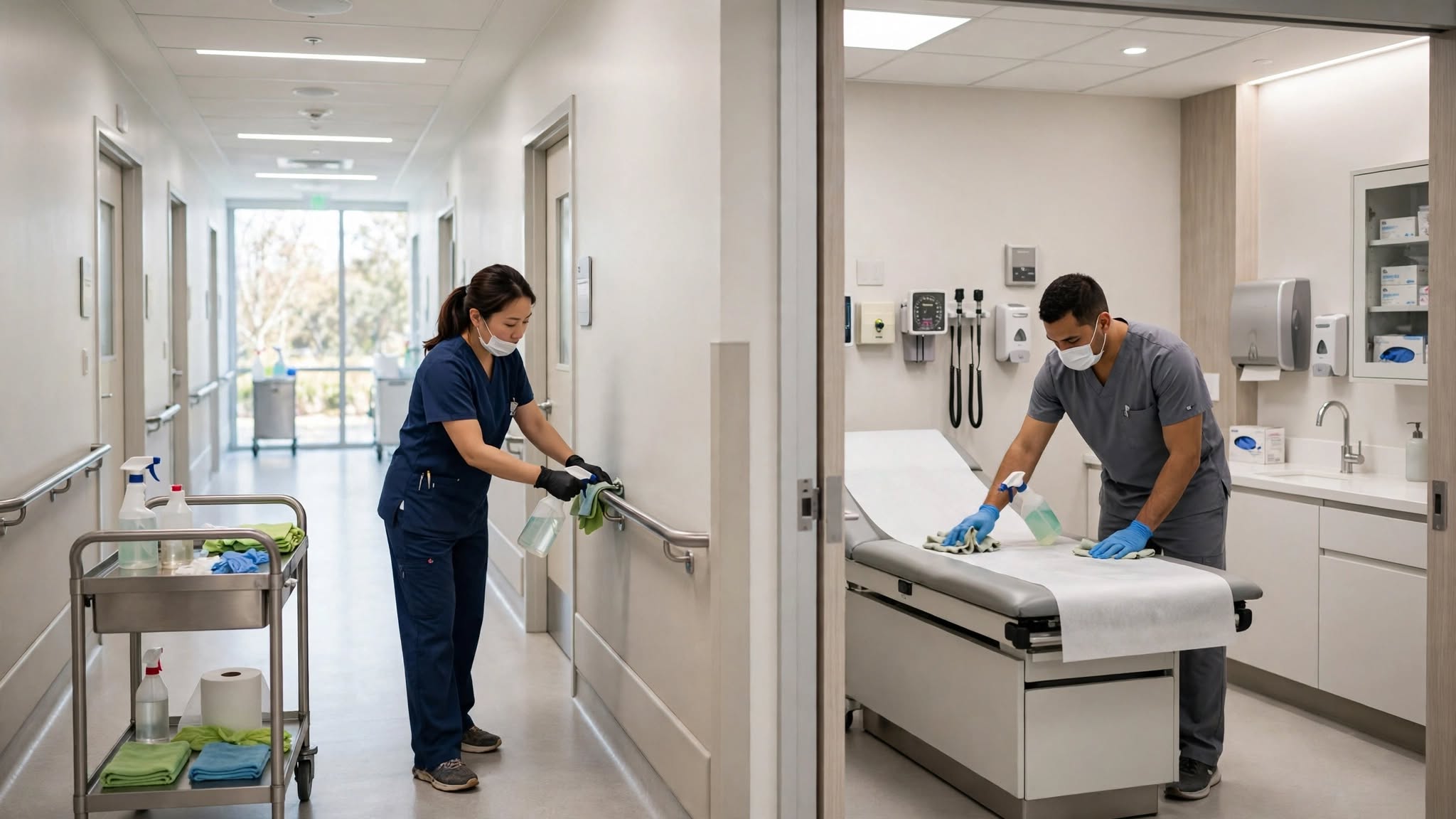
The work itself looks similar to commercial cleaning from a distance. Up close it is different. Cloths are color coded by zone so a cloth used in a restroom never reaches an exam table. Mop heads are changed between rooms rather than wrung out and reused. Disinfectant is applied and left wet for the time the label specifies. Every room is logged. Our medical office cleaning program is built on exactly this model, and it sits on top of our standard janitorial services.
The infection control standard behind the work
The Centers for Disease Control and Prevention reports that on any given day, about 1 in 31 hospital patients has at least one healthcare-associated infection. The CDC trains environmental services personnel as part of infection prevention for that reason, and the training material is explicit that following cleaning and disinfection guidelines is one of the controls that stops transmission.
Two things decide whether a disinfection step works. The first is product selection. The product has to be EPA registered for the organism in question, and the EPA keeps separate lists for different pathogens. The second is dwell time, sometimes called contact time. Every disinfectant label states how long the surface must stay visibly wet for the kill claim to hold. A crew that sprays and immediately wipes has cleaned the surface and disinfected nothing.
Electrostatic spraying has become common in clinics because it coats irregular surfaces evenly and covers a room quickly. It is a delivery method, not a substitute for wiping. Soil has to come off the surface first or the disinfectant lands on top of it.
Daily, discharge, and terminal cleaning
These three terms get used loosely and they are not the same job. The difference matters when you are pricing a contract or reading one.
Daily clean
Covers: floors, trash, restrooms, waiting areas, high-touch points, and corridors.
Typical trigger: every service night.
Discharge or between-patient clean
Covers: exam surfaces, chair, stool, counters, and high-touch points in one room.
Typical trigger: patient turnover, usually handled by clinical staff.
Terminal clean
Covers: the full room top to bottom, including walls, fixtures, curtains, and all horizontal surfaces.
Typical trigger: isolation room release or a procedure room schedule.
Periodic deep work
Covers: floor refinishing, carpet extraction, high dusting, and vent cleaning.
Typical trigger: a quarterly or semiannual schedule. See our deep cleaning services for how this work is scoped.
Zoning a medical building by risk
A medical office building is not one environment. The waiting room, the staff kitchen, and the procedure room carry different risk, and treating them the same wastes money in one place and creates exposure in another.
The usual split is three zones. Low risk covers administrative offices, corridors away from clinical space, and break rooms, where normal commercial cleaning standards apply. Moderate risk covers waiting rooms, reception, patient restrooms, and exam rooms, where high-touch disinfection is added to every clean. High risk covers procedure rooms, isolation rooms, and any area where sterile work happens, where terminal cleaning protocols and documentation apply.
High-touch is the operative phrase in the middle zone. Check-in counters, pens, clipboards, door handles, chair arms, light switches, elevator buttons, and railings get touched by every sick person who walks through the building.
Get a quote
Want this scoped for your building? Call (508) 890-1000 or request a free quote.
What is different about outpatient and medical office sites
A hospital runs 24 hours and has its own environmental services department. An outpatient clinic, a dental practice, a dialysis center, or a specialist office closes at six and opens at seven, which gives a contractor a fixed window and no room to run long. That is the practical difference most medical office managers care about.
The second difference is privacy. Cleaning crews work around charts, screens, and paperwork. Staff should be trained not to move or read patient material, and the contract should say what happens if something is found left out. This is not a HIPAA certification question for the cleaning company, it is a conduct and training question, and the answer should be in the onboarding.
The third is supply discipline. Small sites run out of soap, paper, and liners faster than anyone plans for, and a clinic with an empty dispenser at ten in the morning has a hand hygiene problem, not a housekeeping problem.
How to evaluate a medical cleaning contractor
1. Ask for the product list and the dwell times
You want the EPA registration number and the label contact time for each disinfectant, not a brand name.
2. Ask how cloths and mop heads are controlled
Color coding by zone and single-room mop heads are the baseline. If the answer is vague, the crew is reusing them.
3. Ask who trains the crew and how often
Training for hospital janitorial services should be documented, repeated, and tied to named staff rather than delivered once at hire.
4. Get the waste boundary in writing
Regulated medical waste and sharps stay with clinical staff. Say so in the contract so nobody improvises at midnight.
5. Agree on the documentation you will receive
A room log, a completed checklist, and a named supervisor contact are the minimum. Ask to see a sample from a live account.
6. Check coverage for call-outs
A single-person site means one sick cleaner equals no clean. Ask how absences are covered and how fast.
Coverage across the Merrimack Valley
Lowell anchors the Merrimack Valley medical cluster, with Chelmsford, Billerica, Tewksbury, Dracut, Andover, and Lawrence all within a short drive. For a facilities manager running several sites, that density is useful. One contractor running hospital janitorial services from a crew based in the corridor can cover multiple buildings in a night and move staff between them when somebody calls out. See our commercial cleaning in Lowell, MA page for local coverage.
It also means supervision is realistic. A supervisor who can reach four of your sites in an evening will catch problems before you do. A contractor dispatching from an hour away will not.
About Enterprise Cleaning Corporation
Enterprise Cleaning Corporation has worked out of Central Massachusetts since 2003. Stephen Buchalter, Owner and President, founded the company and still runs it. Julio Biage, Director of Operations, builds the crews and the quality checks behind every contract. The company works from 99 Hartwell Street, Suite B, in West Boylston, serves more than 165 recurring janitorial customers, holds a 97% client retention rate, has won four Worcester Business Journal Best of Business awards, and has held BBB accreditation since 2007. Crews are permanent in-house staff with no subcontractors. Healthcare clients include APDerm, a network of more than 30 clinical locations across Massachusetts, Rhode Island, and New Hampshire (read the APDerm case study), and Shields Healthcare. See all of our medical and healthcare cleaning work.
Ready to talk
Enterprise Cleaning Corporation provides hospital janitorial services for medical offices, clinics, and institutional buildings across Massachusetts. Call (508) 890-1000 or request a free quote and we will walk your site and build a zoned scope with documentation you can hand to an inspector.