Table of Contents
- •Cut to the chase
- •At a glance
- •What school cleaning services actually cover
- •Outbreak season changes the job
- •A realistic schedule for a school building
- -Daily
- -Weekly
- -Monthly
- -Outbreak response
- -Term break
- •Indoor air quality and product choice
- •Get a quote
- •Cafeteria and food service areas
- •How to choose a school cleaning contractor
- -1. Write the scope room by room
- -2. Ask about background checks
- -3. Test the surge capacity question
- -4. Check the product list
- -5. Set the quality check in writing
- -6. Ask for school references in your area
- •About Enterprise Cleaning Corporation
- •Ready to talk
Cut to the chase
School cleaning services cover daily classroom and restroom work during the academic year, high-touch disinfection during outbreak season, and deep floor and furniture work during term breaks. In Central Massachusetts, districts and private schools usually run a nightly crew plus a scheduled deep clean at February, April, and summer breaks. The contractor should be able to surge staff within 24 hours when a stomach bug moves through a building.
At a glance
A Medford elementary school closed for two days in December 2025 after more than 130 students were absent in a suspected norovirus outbreak, and professionals were brought in to deep clean the building.
Norovirus does not die to ordinary quaternary disinfectants. It needs an EPA List G product, which is a different chemical on the cart.
The Massachusetts DPH Indoor Air Quality Program tells schools to avoid air deodorizing products, which can irritate the airways of students and staff.
School cafeterias fall under 105 CMR 590, the same state sanitary code that governs restaurants.
Term breaks, not weekends, are when stripping, waxing, and furniture-out deep cleans actually get done.
What school cleaning services actually cover
A school building is not an office with children in it. The traffic is heavier, the surfaces are touched more often, and the people using the building have weaker immune defenses and worse hand hygiene than adult office workers. School cleaning services are built around that reality. If you are comparing this work to office cleaning, expect more frequent disinfection, tighter product controls, and a much shorter window to get the building ready each morning.
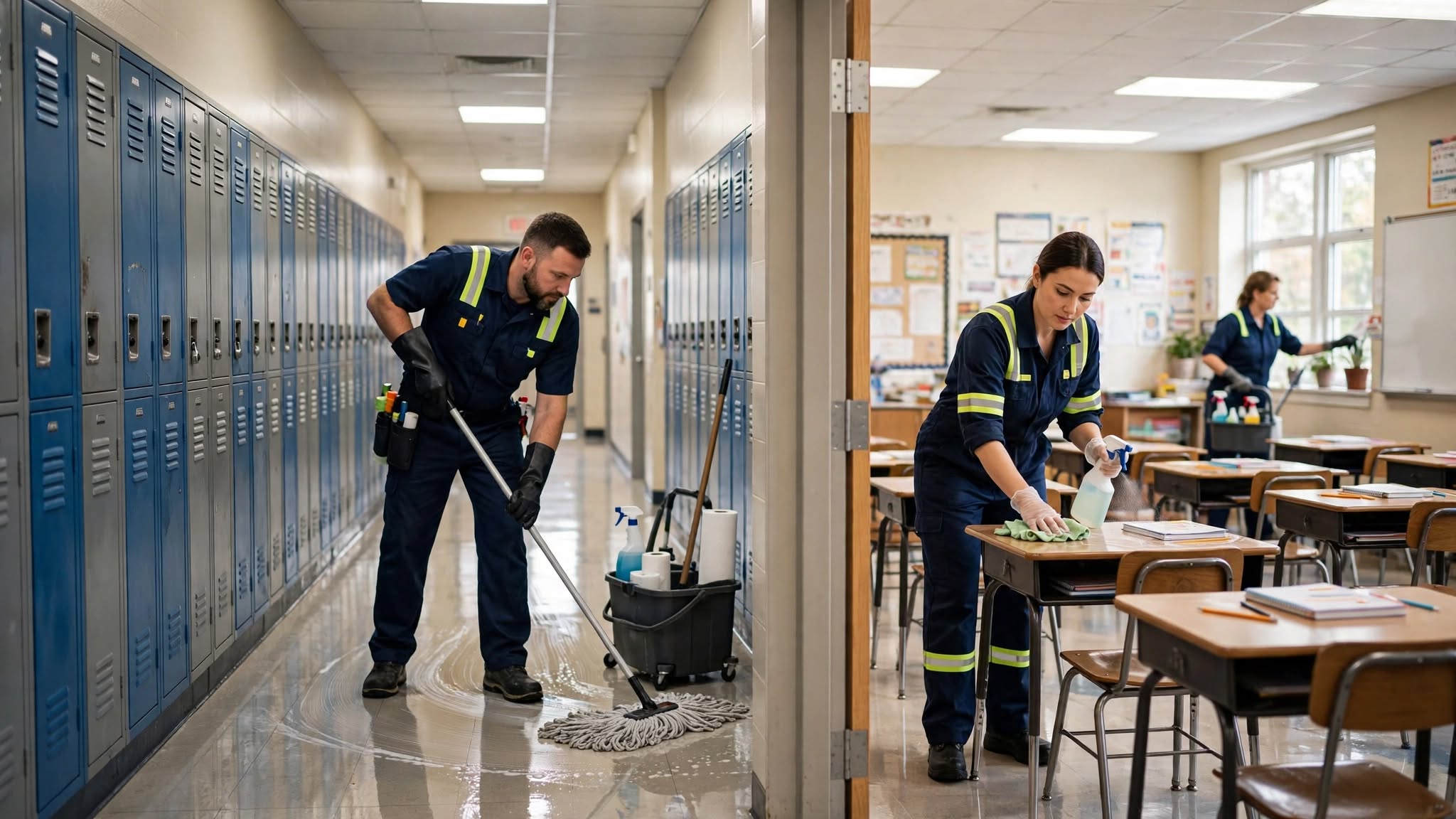
The nightly scope in most Central Massachusetts schools covers classrooms, corridors, restrooms, the main office, the nurse's suite, the gym, and the cafeteria. Classroom work means desks wiped, floors swept and damp mopped, trash and recycling pulled, and high-touch points disinfected. High-touch means door handles, light switches, handrails, water fountain buttons, shared keyboards, and the backs of chairs that students grab when they stand up.
Restrooms get the most scrutiny from parents and the most complaints from staff. They need a full fixture clean, floor disinfection rather than a quick mop, and restocking that does not run out by second period. Gym floors, locker rooms, and wrestling mats sit in their own category because of skin infection risk. For the full picture of what a recurring program includes, see our janitorial services page and our education and municipal cleaning overview.
Outbreak season changes the job
In December 2025, Roberts Elementary School in Medford closed for two straight days after more than 130 students were out sick in a suspected norovirus outbreak. At least 20 staff members were also sick, and professional cleaners deep cleaned the building before classes resumed. That is the scenario every facilities director in Massachusetts is planning against from November through March.
The practical problem is chemical. Norovirus survives most standard quaternary ammonium disinfectants, so a crew running its usual cart will wipe surfaces without killing the thing that closed the school. The EPA publishes List G, a register of products proven effective against norovirus, and these are usually bleach based. A contractor who cannot tell you which List G product they carry and what the contact time is has not thought this through.
The second problem is bodies. An outbreak response means a building covered in one night by a crew several times the size of the nightly team. Ask any prospective contractor how many trained staff they can put in your building on 24 hours notice, and whether those people are their own employees or subcontractors they have to find.
A realistic schedule for a school building
Schools get deep cleaned when the students leave, not on weekends. The schedule below reflects how school cleaning services are actually organized across district and private school contracts in Worcester County.
Daily
Scope: classrooms, restrooms, corridors, cafeteria, trash, and high-touch disinfection.
When: after dismissal, during the school year.
Weekly
Scope: detail dusting, entry glass, gym floor dust mop and damp clean, and locker room detail.
When: one scheduled night per week.
Monthly
Scope: vent and high dusting, floor burnishing, restroom descaling, and furniture spot cleaning.
When: scheduled around the academic calendar.
Outbreak response
Scope: full building disinfection with an EPA List G product, with a high-touch focus.
When: within 24 hours of a district request.
Term break
Scope: strip and wax, carpet extraction, furniture-out classroom resets, and wall washing.
When: February, April, and summer breaks.
The strip and wax work is where floors are won or lost for the year. Our commercial floor care services cover stripping, waxing, burnishing, and maintenance, and the same crew can handle the deep cleaning and disinfection work that goes with a term-break reset.
Indoor air quality and product choice
The Massachusetts Department of Public Health runs an Indoor Air Quality Program that publishes guidance for schools. Two points in that guidance affect cleaning contracts directly. The first is that air deodorizing products should not be used, because they act as respiratory irritants in a building full of asthmatic children. The second is that cleaning supplies need to be properly labeled and properly stored, which is a contract compliance matter as much as a safety one.
In practice this means a school contract should specify the product list, not leave it to whoever is stocking the closet. Fragrance-masking sprays, plug-in air fresheners, and heavily scented floor cleaners all cause complaints in schools and none of them clean anything.
Get a quote
Want this scoped for your building? Call (508) 890-1000 or request a free quote.
Cafeteria and food service areas
School kitchens and serving lines are regulated under 105 CMR 590, the Massachusetts State Sanitary Code Chapter X, which adopts the FDA Food Code with state amendments. The same inspectors who visit restaurants visit school cafeterias, and the same violation categories apply.
Most contracts split this work. Kitchen staff handle food contact surfaces and equipment. The cleaning contractor handles the dining floor, tables, chairs, trash, and the hard floor under and around the serving line, where grease and spilled milk build up. Get that line drawn in writing before the contract starts, because it is the most common source of argument between a district and its vendor.
How to choose a school cleaning contractor
1. Write the scope room by room
A scope that says "clean classrooms nightly" will be read one way by you and another way by the crew. List the tasks, the frequency, and the rooms.
2. Ask about background checks
Massachusetts districts generally require background screening for vendors working in school buildings. Ask the contractor what their process is, who is screened, and how often it is refreshed, and confirm the requirement with your district's own policy.
3. Test the surge capacity question
Ask how many trained people they can field in your building within 24 hours for an outbreak response, and ask for an example of when they last did it. Ask too whether the crew is permanent in-house staff or subcontracted.
4. Check the product list
Request the chemical list and SDS sheets up front. Look for an EPA List G product for norovirus and the absence of air deodorizers.
5. Set the quality check in writing
Agree on a walkthrough schedule, who attends, and what happens when something fails. A monthly joint inspection with a signed sheet prevents most disputes.
6. Ask for school references in your area
A contractor already running school cleaning services in Worcester County knows the calendar, the inspection cycle, and the February break crunch. If your campus is in or near the city, our commercial cleaning in Worcester, MA page lists the area we cover.
About Enterprise Cleaning Corporation
Enterprise Cleaning Corporation has worked out of Central Massachusetts since 2003. Stephen Buchalter, Owner and President, founded the company and still runs it. Julio Biage, Director of Operations, builds the crews and the quality checks behind every contract. The company works from 99 Hartwell Street, Suite B, in West Boylston, serves more than 165 recurring janitorial customers, holds a 97% client retention rate, has won four Worcester Business Journal Best of Business awards, and has held BBB accreditation since 2007. Crews are permanent in-house staff with no subcontractors. Clients include Workers Credit Union, APDerm, Shields Healthcare, and Capital Group Properties.
Ready to talk
Enterprise Cleaning Corporation provides school cleaning services and institutional building care across Worcester County and Central Massachusetts. Call (508) 890-1000 or request a free quote and we will walk your building and put a room by room scope in writing.